Caspian sea etiketine sahip kayıtlar gösteriliyor. Tüm kayıtları göster

11 Şubat 2014 Salı

Azerbaijan offers Iraq access to Europe gas pipelines


AFP

Azerbaijan has offered Iraq access to the "Southern Gas Corridor" connecting the Caspian Sea to the European Union to help Baghdad sell natural gas to Europe, Baku's foreign minister said Monday.

Elmar Mammadyarov told journalists in the Iraqi capital that officials in Baghdad had already expressed interest in joining the massive project, which is supported by the United States and aims to reduce Europe's dependence on gas from Russia.

"It's a huge project ... and it's open if Iraq is also interested to deliver their own natural gas," Mammadyarov said at a joint news conference with his Iraqi counterpart Hoshyar Zebari.

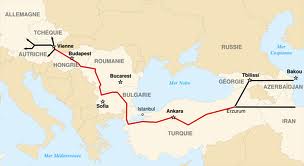
"The project is there, so if any other countries ... want to join the Southern Gas Corridor, including Iraq, who already expressed some interest for this project, we are ready to start negotiations." Gas pumped from the immense new Shah Deniz II field will travel across Azerbaijan and Georgia and across Turkey through a new Trans-Anatolian Pipeline, which is set to be a key part of the Southern Gas Corridor from the Caspian Sea to Turkey and the EU.

Russia, meanwhile, backs a new pipeline under construction known as South Stream that aims to transport 63 billion cubic metres under the Black Sea to Europe.

25 Eylül 2013 Çarşamba

EU Diplomats: "Failed Nabucco West plan still on EU priority list"


REUTERS

The Nabucco West pipeline, which lost a contest to ship Azeri gas to Europe, is still on a list of projects eligible for EU cash, implying the European Commission still believes it could be built, EU diplomats said.

The Commission, the EU executive, next month is expected to publish a final list of projects judged significant to more than one EU nation and entitled to accelerated planning approval as well as consideration for money from the EU budget.

Commission officials declined to disclose the content of the list before publication.

But the diplomats, speaking on condition of anonymity, said it included the Nabucco West scheme, led by OMV, as well as the Trans Atlantic Pipeline (TAP), which was selected to by the Shah Deniz gas consortium to carry gas to Europe.

TAP includes Norway's Statoil, BP, SOCAR, Fluyxs, Total, E.ON Ruhrgas of Germany and Swiss company.
Commission officials have repeatedly said Nabucco West is not dead and could one day be built if more Caspian gas becomes available.

Other schemes on the list of roughly 200 Projects of Common Interest include a Baltic energy grid, aimed at ending the isolation of Baltic states and curbing their reliance on Russia.

A feasibility study for a gas link from Cyprus to Crete and then Greece or Italy is also on the list.
Cyprus has high hopes of rapidly developing its gas reserves to revive its broken economy, but export routes are complicated by its long-standing rift with Turkey.

31 Mayıs 2013 Cuma

Turkey to begin negotiations on gas supplies from Turkmenistan

Trend

A framework agreement on cooperation for the supply of natural gas from Turkmenistan to Turkey can be called an illustrative result of the talks between the presidents of Turkmenistan and Turkey, Gurbanguly Berdimuhamedov and Abdullah Gul, who is on a state visit to Ashgabat.

Ankara periodically expresses its interest in the delivery of Caspian energy to Europe through Turkey, and the issue has been on the agenda since the mid nineties.

It is necessary to lay a 300-km pipeline under the Caspian Sea to Azerbaijan for the delivery of Turkmen resources to Europe. From there, the fuel reaches Turkey, which shares borders with Europe. The Trans-Caspian project could become a part of several large-scale projects such as Nabucco, AGRI and TANAP in which Ankara takes an active part.

The Trans-Caspian project at this stage is considered by experts as the most optimal way to deliver Turkmen gas to Europe.

Official Ashgabat believes that the consent of the parties, territories of which are covered by the project (Turkmenistan and Azerbaijan), is sufficient for laying the pipe under the Caspian Sea.

Baku has expressed readiness to provide its territory, transit opportunities and infrastructure for its implementation, as reported by the representatives of the State Oil Company of Azerbaijan (SOCAR).

Source:  http://en.trend.az/capital/energy/2156037.html

29 Mayıs 2013 Çarşamba

Russian gas pipeline could doom Europe's Nabucco plan

Reuters


* Europe, U.S. support for Nabucco weakened
* Azeri consortium expected to pick winner in June
* Gas due to flow to European Union from 2019

Europe's grand plan for a gas pipeline from the Caspian Sea that would make its eastern states less reliant on Russia may have been fatally undermined by Russia's even bigger project.

As Azerbaijan nears a decision on which pipeline to choose for its future exports, the Nabucco plan that was long the European Union favourite could lose out to the more modest Trans Adriatic Pipeline (TAP) across Greece to southern Italy.

In a complex equation based on politics as much as economics, TAP is in the ascendancy over the Nabucco pipeline to Austria in the face of Russia's $39 billion South Stream plan.

"The question is: 'Is Nabucco viable if South Stream is built?'" said Andrew Neff, Moscow-based principal energy analyst with research firm IHS.

The decision between TAP and Nabucco is expected in June from partners in the Shah Deniz consortium, led by gas field operator BP and Azeri state energy company Socar.

The European Union won't have a direct say in the choice, but its recent switch to "project neutrality" from support for Nabucco could make a big difference. It now says it would be happy with either pipeline or even both.

"There has been a dramatic shift," TAP's External Affairs Director Michael Hoffmann told Reuters.

Nabucco spokesman Christian Dolezal, however, said his project retained strong political support.

20 Mayıs 2013 Pazartesi

Nabucco West and TAP: Going head to head


Amanda Paul     Today's Zaman


At the end of June, the long-awaited decision regarding which pipeline will be selected to transport natural gas from Azerbaijan’s Shah Deniz II field across Turkey to the EU market will be made.
 
This decision will be followed by the final investment decision in late 2013. Production is expected to begin in 2018 at some 16 billion cubic meters (bcm) per year: 10 bcm for Europe and 6 bcm for Turkey.

Last year the field of runners was narrowed to two: Nabucco West and the Trans-Adriatic Pipeline (TAP). The available gas is only enough to fill one of them. Both projects not only have economic but also political implications.

Officials from both Nabucco West and TAP are currently engaged in major lobbying campaigns to promote their respective projects to the Shah Deniz partners, the Azerbaijani government and the developers of the proposed TANAP pipeline across Turkey that would feed into their projects. While the Shah Deniz II Consortium will present their opinion to Azerbaijan over which pipe should be chosen, Azerbaijan is not obliged to follow this advice.

Nabucco West has always been labeled a geostrategic project. It would ship gas from Turkey’s western border via Bulgaria, Romania and Hungary and into the Baumgarten hub in Austria and into Central and Eastern Europe where it is badly needed with many of the countries heavily, or in some cases fully dependent, on Russian gas.

27 Nisan 2013 Cumartesi

TAP Countries Give Tripartite Support


Natural Gas Europe

The governments of Albania, Greece and Italy have created a special committee to coordinate support for the Trans-Adriatic Pipeline (TAP), one of two major contenders for the contract to convey gas from the Shah Deniz 2 field off Azerbaijan.

External Affairs Director for TAP, Michael Hoffmann, said the support was a major vote of confidence in his consortium, which is led by Norwegian major Statoil.

TAP is included in the so-called Southern Corridor, a planned network of pipelines meant to offer alternatives to Russian gas for Europe.

Albania, Greece and Italy are all transit countries for TAP. When the gas supplies arrive in Italy, they will then be transported on to a range of customer countries, according to the plan.

TAP is up against the ambitious Nabucco West pipeline, which is backed by other European countries. Also on Wednesday, the Nabucco website recorded a call by Austria, Bulgaria, Hungary and Romania to support his alternative in the Shah Deniz decision.

On Monday the New York Times reported that Hungarian prime minister Mark Orban had said that MOL, his contry's participant in Nabucco West, wanted to withdraw from the project.

A BP-led consortium operating Shah Deniz is due to decide on the successful candidate by June.

Source: http://www.naturalgaseurope.com/tap-countries-give-tripartite-support

29 Mayıs 2012 Salı

The energy wars heat up


Michael KLARE*     Le Monde Diplomatique

Six recent clashes and conflicts on a planet heading into energy overdrive

Conflict and intrigue over valuable energy supplies have been features of the international landscape for a long time. Major wars over oil have been fought every decade or so since World War I, and smaller engagements have erupted every few years; a flare-up or two in 2012, then, would be part of the normal scheme of things. Instead, what we are now seeing is a whole cluster of oil-related clashes stretching across the globe, involving a dozen or so countries, with more popping up all the time. Consider these flash-points as signals that we are entering an era of intensified conflict over energy.

From the Atlantic to the Pacific, Argentina to the Philippines, here are the six areas of conflict — all tied to energy supplies — that have made news in just the first few months of 2012:

* A brewing war between Sudan and South Sudan: On April 10th, forces from the newly independent state of South Sudan occupied the oil center of Heglig, a town granted to Sudan as part of a peace settlement that allowed the southerners to secede in 2011. The northerners, based in Khartoum, then mobilized their own forces and drove the South Sudanese out of Heglig. Fighting has since erupted all along the contested border between the two countries, accompanied by air strikes on towns in South Sudan. Although the fighting has not yet reached the level of a full-scale war, international efforts to negotiate a cease-fire and a peaceful resolution to the dispute have yet to meet with success.

12 Ağustos 2011 Cuma

Turkey’s Role in European Energy Security


Dr. Mehmet Efe Biresselioglu*   Natural Gas for Europe      

Ankara’s geography can help boost European energy security

An expert in European geopolitics in the Department of International Relations and the EU at Turkey’s Izmir University of Economics, Dr. Mehmet Efe Biresselioglu contended that there were some basic problems with European energy policy.

“The political reality of the European Union changes when it is faced with energy issues,” he explained. “The EU is divided into two different poles: there are the national decision making centers on one hand, and the EU institutions with powerful transnational political resources on the other. So basically in spite of the liberal inter-governmental setting, and fully integrated political policies, these two different poles mean that the EU is divided over a common energy policy.

“The main obstacle to progress in energy policy is basically the various preferences of the member states, all of which have their different domestic energy resources, different energy requirements and large, state-owned, monopolistic energy industries. All the states have different preferences.”

26 Temmuz 2011 Salı

Azerbaijan looks favorably on Nabucco for diversification


 Abdullah Bozkurt        Today's Zaman

Azerbaijan Minister of Economic Development Shahin Mustafayev has said his country is approaching the European Union-backed Nabucco pipeline project “in a very positive manner.”

Mustafayev, speaking to Today's Zaman in Baku last week, said the Nabucco project, which aims to carry Caspian natural gas supplies to European markets while bypassing the Russian route, is very important in terms of diversification of Azerbaijani energy policies.

“We have to look at the supply side of gas and should enlist more suppliers for Nabucco. The rights of all producers, consumers and transit countries must be protected as well,” he explained.

Nabucco is in competition with two other alternative pipeline projects, namely Interconnector Turkey-Greece-Italy (ITGI) and the Trans Adriatic Pipeline (TAP). All three pipelines will have to pass through Turkey or link to the country's existing network. Following the examination of detailed proposals in October, Azerbaijan is expected to decide which project to prioritize before the end of 2011.

25 Temmuz 2011 Pazartesi

Azerbaijan questions Turkey’s Nabucco moves


İpek Yezdani     Hurriyet Daily News and Economic Review

Azerbaijan has questioned Turkey’s attitude on the Nabucco pipeline project after Baku failed to receive a copy of the signed contract from Ankara, according to a top official from the Caspian nation.

 “Unfortunately nobody sent us the copy of this Project Support Agreement,” Elshad Nasirov, the vice president of the State Oil Company of Azerbaijan, or SOCAR, told the Hürriyet Daily News during a recent interview. “And we will not ask for it, because this will violate the principle of equal treatment for … three projects – Nabucco, the Trans Adriatic Pipeline [TAP] and the Interconnection Turkey-Greece-Italy [ITGI].”
Azerbaijan was the only project partner absent when the legal framework for the Nabucco Pipeline was reportedly signed and finalized on June 8 for the project support agreements, or PSAs, between Nabucco Gas Pipeline International GmbH and the responsible ministries of the five transit countries, Austria, Bulgaria, Hungary, Romania and Turkey.

The signature ceremony was organized just before Turkey’s June 12 general elections in the Central Anatolian province of Kayseri, where Turkish energy minister was running for a seat in Parliament.

22 Haziran 2011 Çarşamba

Nabucco chances grow as Europe’s atomic future dims


Michael KAHN / Sylvia WESTALL

9 Nisan 2011 Cumartesi

Turkish-Azeri Gas transit deal may ease caspian supply to Europe


Bloomberg 

Turkey and Azerbaijan will sign a deal for the transit for gas from the Shah Deniz-2 Caspian Sea deposit “shortly,” according to an Azeri official, boosting European plans to diversify supplies away from Russia.
“Everything will be signed very shortly, in several weeks,” Elshad Nassirov, vice president for marketing and investment at the State Oil Co. of Azerbaijan, or Socar, said in an interview in the Azeri capital Baku late Thursday.

All major issues, such as the price and volume of gas to be sold to Turkey from Shah Deniz-2, as well as tariffs for the transportation of fuel through the existing and future pipelines in Turkey have been agreed upon, Nassirov said, without providing details.

The European Union is looking to the Caspian, including Azerbaijan and Turkmenistan, to diversify supply, offset dwindling production and reduce dependence on Russia. Pipeline projects in the bloc’s so-called southern corridor, including OMV-led Nabucco, are seeking supply from Shah Deniz, one of the world’s biggest deposits, as is Russia’s Gazprom.

25 Mart 2011 Cuma

Nabucco Project Adds Options For Gas Producers And Consumers


Vladimir Socor     Eurasia Daily Monitor, Volume: 8, Issue: 56

The Nabucco pipeline consortium is planning an expanded version of this project, within the framework of the EU-backed Southern Gas Corridor to Europe. The added elements include, as distinct possibilities: linking up with Turkmenistan through a trans-Caspian pipeline, to connect with Nabucco via Azerbaijan; inviting Azerbaijan to join the Nabucco consortium; substantially raising the production target for the Shah Deniz field’s Phase Two of development in Azerbaijan; and linking the Nabucco trunkline with the transmission systems of countries in Southeastern and Central Europe, not only along Nabucco’s linear route to Vienna, but also laterally with neighboring countries, thus multiplying the marketing options for Caspian gas in Europe.

Nabucco consortium executives presented some of these planning developments during the annual Turkish Oil & Gas Conference (TUROGE) held on March 17 in Ankara. This process is also ongoing in Baku and, with the European Commission’s assistance, in Ashgabat.