Pipeline Politics etiketine sahip kayıtlar gösteriliyor. Tüm kayıtları göster

25 Mart 2014 Salı

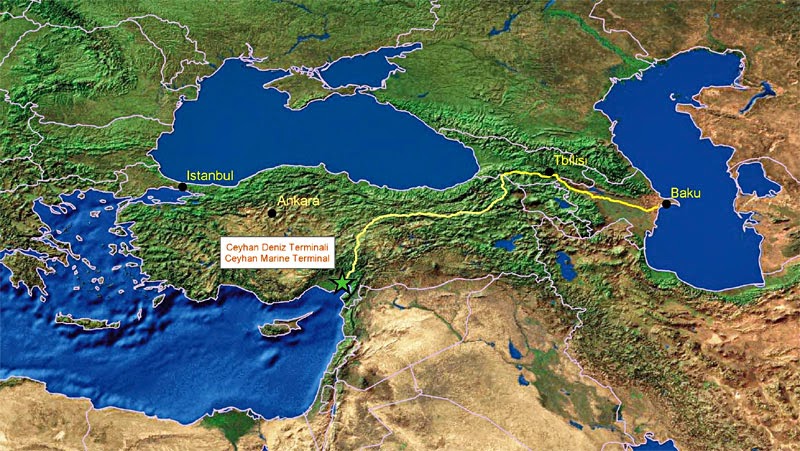
Turkey ‘earns $12 billion’ from Baku-Tbilisi-Ceyhan (BTC) Pipeline


AA

The Turkish Petroleum Corporation (TPAO) has earned $12 billion from the Baku-Tbilisi-Ceyhan (BTC) crude oil pipeline since 2005, when oil from Baku was first pumped, Turkish Minister of Energy Taner Yıldız has said.

During his speech in the southern province of Adana, Yıldız underlined the importance of the BTC pipeline for the region and trade volume created for the country.

He stated the TPAO has 6.5 percent of the shares in the BTC crude oil pipeline. British Petroleum (BP) and State Oil Company of the Azerbaijan Republic (SOCAR) hold the majority of the shares in the BTC pipeline, with 30 percent and 20 percent respectively. 

The pipeline has transported more than 1.8 billion barrels of crude oil to date.

Nearly 3 percent of the world’s oil trade is flowing along the BTC and Kirkuk-Yumurtalık crude oil pipelines through Turkey. The BTC pipeline has been transporting Azeri oil from the Caspian Sea to the Ceyhan Port of Turkey through the Georgian capital of Tblisi. The oil is then exported to European markets via the Mediterranean Sea.

20 Mart 2014 Perşembe

Gazprom Proposes Oil And Gas Development In Crimea


Reuters

Russian state-owned energy company Gazprom has proposed to develop Crimea's oil and gas sector, an official of the Ukrainian region which has applied to join Russia was quoted by RIA news agency as saying on Tuesday.

"Of course, Gazprom was the first to approach us (with a proposal)," said Rustam Temirgaliev, Crimea's first deputy prime minister.

He was asked if the Ukrainian region, which declared its independence and applied to join Russia following a weekend referendum, had received proposals from Russian companies to develop its oil and gas industry.

A Gazprom spokesman declined comments.

Last week, Temirgaliev said that the local authorities may sell the energy firm Chornomornaftohaz to a Russian company "such as Gazprom" once the region takes control the firm, which is now part of a Ukrainian state energy company.

A Moscow-backed referendum in Crimea on Sunday showed overwhelming support for joining the Russian Federation.

European leaders seek ways to curb dependence on Russian gas


Reuters

European leaders will seek ways to cut their multi-billion-dollar dependence on Russian gas at talks in Brussels on Thursday and Friday, while stopping short of severing energy ties with Moscow for now.

Russia's seizure of Ukraine's Crimea region has revived doubts about whether the European Union should continue to rely on Russia for nearly a third of its gas, providing Gazprom with an average of $5 billion per month in revenue. Some 40 percent of that gas is shipped via Ukraine.

EU powerhouse Germany is among those with particularly close energy links to Russia and has echoed comments from Gazprom, Russia's top natural gas producer, that Russia has been a reliable supplier for decades.

Russian supplies of gas to the EU were disrupted in 2006 and 2009, but only because of knock-on effects when Moscow cut off Ukraine for not paying its bills. Although those incidents resulted in EU attempts to diversify its energy sources, contracts to the bloc have always been honoured.

EU officials said the current Ukraine crisis, however, had convinced many in Europe that Russia was no longer reliable and the political will to end its supply dominance had never been greater.

"Everyone recognises a major change of pace is needed on the part of the European Union," one EU official said on condition of anonymity.

"At the back of people's minds, there will always be the doubt that if the relationship goes sour, Russia has that weapon and it's not something it should have," another official said, referring to Russia's option of severing supplies.

23 Şubat 2014 Pazar

Jordan, Iraq preparing to tender $18b oil pipeline


The Jordan Times

Work to construct a $18 billion oil pipeline from Iraq’s Basra to Jordan’s port city of Aqaba may start soon, as officials from both coutries are meeting with international firms interested in the mega-project, an official said Saturday.

Jordan and Iraq are speeding up their measures and efforts to construct the pipeline, a senior official at the Aqaba Special Economic Zone Authority (ASEZA) told The Jordan Times.

The official, who preferred to remain unnamed,  said that Jordanian and Iraqi officials held meetings last week in Aqaba with several international companies that showed interest in carrying out the scheme, adding that work on the project is set to begin soon.

Once completed –– the pipeline is projected to export 2.25 million barrels of oil per day through the Kingdom. It would generate between $2 billion and $3 billion a year in revenues for the Kingdom, according to estimates of Iraqi and Jordanian officials.

The source said that Jordanian and Iraqi officials had agreed to prepare copies of the tenders from the Iraqi side.

13 Aralık 2013 Cuma

Cyprus and Egypt sign unitisation deal on the joint exploitation


 Cyprus Mail

Cyprus and Egypt yesterday signed a unitisation agreement on the joint exploitation of hydrocarbon reserves, on the median line between the two countries’ respective exclusive economic zones (EEZ).

The seminal agreement paves the way for commercial interests to take advantage of any hydrocarbon reserves found in areas that could cross either side of the dividing line between the two countries’ EEZ.

In total, three bilateral agreements were signed yesterday during President Nicos Anastasiades’ two-day official visit to Cairo, marking an upturn in relations between Cyprus and the interim government of Egypt.

Foreign Minister Ioannis Kasoulides signed a Revised Aviation Agreement between Egypt and Cyprus while Energy Minister Giorgos Lakkotrypis signed a framework agreement for the Development of Cross-Median Line Hydrocarbon Resources.

A cooperation agreement was also signed between the Cyprus Institute of Neurology and Genetics and the Children’s Cancer Hospital of Cairo.

The unitisation agreement is a final agreement between two governments, and the first one signed between Cyprus and one of its neighbours, with significant implications for the development of the industry in the Eastern Mediterranean.

2 Aralık 2013 Pazartesi

Turkey says wants to draw Baghdad into Kurdish oil deal


Reuters       Humeyra Pamuk

Turkey said on Monday it stood by a bilateral oil deal with Iraq's Kurdistan region that bypassed central government but wanted to win Baghdad's support by drawing it into the arrangement.

Reuters reported that Turkey and Iraqi Kurdistan signed a multi-billion-dollar energy package last week, infuriating a central Baghdad government which claims sole authority over Iraqi oil exports and is wary of any moves that could extend political autonomy to the region.

Turkish Energy Minister Taner Yildiz met Iraq's deputy prime minister for energy, Hussain al-Shahristani, in Baghdad on Sunday to try to mend ties with a federal government which says independent Kurdish oil exports would be illegal. The affair has soured relations between Ankara and Baghdad.

"We stand by the agreement we did with northern Iraq but we hope this can be carried out through a three-way mechanism," Yildiz told a conference in Arbil, the capital city of the Kurdistan region (KRG). "As Turkey, we are trying to move this forward in a careful and courteous way."

"We also would like to have the consent of the Central Government of Iraq for the commercial export of oil from the KRG to Turkey and start a trilateral cooperation scheme that will be beneficial to all."

The Kurdish north of Iraq has enjoyed autonomy since the 1990-1991 Gulf War when a U.S.-led coalition drove Iraqi occupying troops out of Kuwait.

23 Kasım 2013 Cumartesi

US urges talks for energy in East Med


Hürriyet Daily News

The United States has called for continued dialogue between Turkey and the relevant parties in exploring energy resources both in the Eastern Mediterranean as well as in Iraq.

Carlos Pascual, the U.S. special envoy, called for dialog among parties on the potential resources that are yet to be explored in the Eastern Mediterranean, at the Atlantic Council Summit in Istanbul.
Discoveries of significant amounts of gas around Cyprus have brought with them political problems, as Turkey raised objections about exploration and ownership rights before a political settlement was reached on the divided island. Strains in Israeli–Turkish relations further complicated the transport of gas to a European market via Turkey, which experts agree will be the most commercial way.

It is too early to predict how Eastern Mediterranean gas will reach international markets according to Pascual, who said conversations between countries and companies would be critical to find the most commercially viable and politically acceptable solution.

Meanwhile Leonardo Bellodi, senior vice-president for public Affairs of ENİ said “things looked improved compared to a year ago,” when asked by the Hürriyet Daily News. Turkey had warned companies last year not to go ahead with exploration works in the Mediterranean or face consequences.

Greek Cyprus to auction gas exploration blocks

AFP

Greek Cyprus has entered talks with Italian-South Korean venture ENI-KOGAS on licensing two offshore exploration blocks, state media said, as the recession-hit island steps up its search for gas reserves.

The cabinet reportedly gave the green light for the negotiations on blocks 5 and 6 to begin, with a December 2 deadline ready to be extended. Government spokesman Victoras Papadopoulos confirmed ministers had discussed the issue but told reporters there was “nothing to announce publicly.”

Earlier this year, ENI-KOGAS secured permits to exploit possible hydrocarbon deposits in blocks 2, 3 and 9. The venture plans to start drilling in the third quarter of 2014.

20 Kasım 2013 Çarşamba

Iraq Kurds to Pump Oil to Turkey in Truce With Baghdad


Bloomberg        Selcan Hacaoğlu & Onur Ant

Iraq’s Kurds plan to start pumping oil to Turkey next month via a pipeline controlled by the central government in Baghdad, signaling an easing of their dispute over resources, according to two people familiar with the plan.

The new line will take Kurdish oil into the existing pipe that runs from Kirkuk in Iraq to Turkey’s Mediterranean port of Ceyhan, initially carrying 150,000 barrels a day starting in December, according to the Turkish energy industry officials who asked not to be identified because the information isn’t public. An Iraqi energy industry manager, who requested anonymity for the same reason, said the state oil company has accounted for the extra oil in 2014 plans.

Ashti Hawrami, the Kurdish Regional Government’s natural resources minister, said at a press conference last month that the 40-kilometer pipeline will have a capacity of 300,000 barrels a day. Mehmet Sepil, president of London-listed Genel Energy, said at the same conference that the pipeline from Dohuk to Fishkabur on the Turkish border will carry 200,000 barrels a day from its Tawke and Taq Taq fields.

The Iraqi official said the Kurdish oil will be metered when it feeds into the main pipeline, at Fishkabur near the Turkish border, and again when it arrives at Ceyhan.

The agreement signals a truce on the issue between the Iraqi Kurds, who say they should have control over oil and gas resources in the north, and the Baghdad government, which argues that all energy transactions need central approval.

12 Kasım 2013 Salı

Iraq’s Kurdish region pursues ties with Turkey — for energy revenue and independence


The Washington Post   Ben Van Heuvelen

As the rest of Iraq descends into a crisis of deepening violence, the autonomous enclave of Kurdistan is enlisting the help of an unlikely ally, Turkey, to reach for a long-delayed dream of independence.

In many ways, Iraqi Kurdistan already acts like a sovereign state. Kurdish authorities provide all public services, command their own army and control their own borders — including their heavily guarded southern border with ­Arab-majority provinces of Iraq. In Irbil, the Kurdish capital, most government buildings fly the Kurdish flag — not the flag of Iraq — and many members of the younger generation never learned Arabic and speak only Kurdish.

Until now, however, the Kurds have remained tightly tied to Baghdad because they depend on the Iraqi treasury for the vast majority of their regional budget.

That could soon change.

Putting aside years of hostility, Turkish and Kurdish leaders are quietly implementing an energy partnership agreement, signed earlier this year, that promises to provide the Kurdistan region with an independent stream of oil revenue.

The first major step in the plan is a pipeline that runs directly to Turkey, beyond Baghdad’s reach, and that will begin operating by the end of the year, according to the Kurdistan region’s minister of natural resources, Ashti Hawrami.

“It is our duty as Iraqis to pursue export routes for oil and gas, to secure our future,” Hawrami said.

Israel set to become major gas exporter


The Financial Times   John Reed


The Tamar deepwater natural gas platform rises 290m from the seabed off Ashdod, in southern Israel, emerging above the waterline only for the last 50 metres or so.
 
The $3.5bn project is described by its investors Delek of Israel and Noble Energy of the US as the largest private sector infrastructure undertaking in Israel’s 65-year history. The gas from Tamar, which began sending its output onshore in late March, will contribute about a percentage point of the country’s gross domestic product this year.
Israel is on the threshold of becoming a major energy power in the Middle East – with potentially game-changing consequences for geopolitics and economic relations in a volatile region – after a court decision unlocked the path to exports.
 
Executives at Delek and Noble told the Financial Times they are fast-tracking discussions on a range of export options for the much larger, still undeveloped Leviathan field, which lies about 30km to Tamar’s west, and holds an estimated 19tn cubic feet of gas – one of the industry’s biggest recent deepwater finds of its kind.

They are moving forward following a decision by Israel’s supreme court in late October to reject petitions brought by civil society groups and opposition politicians who questioned the right of Benjamin Netanyahu’s government to set aside 40 per cent of Israel’s gas windfall for exports without having consulted the Knesset, Israel’s legislature. 

8 Kasım 2013 Cuma

Iraq vows to work with BP on controversial oil field

AFP

Iraq said Wednesday it would proceed with work alongside British energy giant BP on a controversial northern oilfield, in a move likely to spark anger in the country's Kurdish region.

The development of the Kirkuk oilfield, which lies amid a swathe of disputed territory in north Iraq, is at the heart of a row over land, oil revenues and the powers of the central government that has been raging for years between Baghdad and the autonomous Kurdistan region.

Iraqi Oil Minister Abdelkarim al-Luaybi, Kirkuk provincial Governor Najm al-Din Omar Karim and BP chief executive Bob Dudley visited the field after holding talks in the province's eponymous capital.

"The contract with the British company will be executed by treating the decline in oil production at Kirkuk oilfield, which has reached 230,000 barrels (per day), and the company will work on surveying the fields and sites of Kirkuk oilfield throughout the contract period," Luaybi told AFP.

Current output represents a significant drop off from the field's peak, and Iraqi officials hope to increase production to 500,000 barrels per day in three years.
 

7 Kasım 2013 Perşembe

Turkey, Iraqi Kurdistan clinch major energy pipeline deals


REUTERS        Hümeyra PAMUK & Orhan COSKUN

Iraqi Kurdistan has finalized a comprehensive package of deals with Turkey to build multi-billion dollar oil and gas pipelines to ship the autonomous region's rich hydrocarbon reserves to world markets, sources involved in talks said on Wednesday.

The deals, which could have important geo-political consequences for the Middle East, could see Kurdistan export some 2 million barrels per day (bpd) of oil to world markets and at least 10 billion cubic meters per year of gas to Turkey.

Such a relationship would have been unthinkable just a few years ago, when Ankara enjoyed strong ties with Iraq's central Baghdad government and was deep in a decades-long fight with Kurdish militants on its own soil.

But Turkey imports almost all of its energy needs and growing demand means it faces a ballooning deficit, making the resources over its southeastern border hard to ignore.

During a visit to Istanbul last week by Kurdistan Regional Government (KRG) prime minister Nechirvan Barzani, both sides agreed on the fundamentals of the deals and mapped out technical details for a second oil pipeline and a gas route from Iraq's north to Turkey, sources involved in the talks said.

7 Ekim 2013 Pazartesi

U.S. Is Overtaking Russia as Largest Oil-and-Gas Producer


Photo: AFP
The Wall Street Journal              
Russel GOLD  and Daniel GILBERT 

    The U.S. is overtaking Russia as the world's largest producer of oil and natural gas, a startling shift that is reshaping markets and eroding the clout of traditional energy-rich nations.

    U.S. energy output has been surging in recent years, a comeback fueled by shale-rock formations of oil and natural gas that was unimaginable a decade ago. A Wall Street Journal analysis of global data shows that the U.S. is on track to pass Russia as the world's largest producer of oil and gas combined this year—if it hasn't already.

    The U.S. ascendance comes as Russia has struggled to maintain its energy output and has yet to embrace technologies such as hydraulic fracturing that have boosted American reserves.

    "This is a remarkable turn of events," said Adam Sieminski, head of the U.S. Energy Information Administration. "This is a new era of thinking about market conditions, and opportunities created by these conditions, that you wouldn't in a million years have dreamed about."

    25 Eylül 2013 Çarşamba

    Turkey's pipe dreams


    Arabian Business       Lionel Mok

    Turkey has continued to make the headlines in the Middle East’s oil and gas industry over the last several months due to a number of factors which include the growing divide between the Kurdistan Regional Government (KRG) and the Federal Government of Iraq (FGI); and the recent signing of the Trans-Adriatic Pipeiline (TAP) and Trans-Anatolian Pipelines (TANAP).

    Despite its unremarkable national oil production industry that produces, on average, 50,000 barrels per day (bpd) from reserves that total approximately 270 million barrels of oil, the country has made itself critical to the world’s energy market, while also managing to satisfy growing domestic consumption of over 700,000 bpd.

    Turkey owes its gravitational pull in the energy market to its physical geography. As the only landmass standing between the Middle East and Europe, and also the Black and Mediterranean Seas, Turkey is well positioned to become an energy hub and a transit point.

    The country is in proximity to 71.8% of the world’s proven gas reserves and 72.7% of the world’s proven oil reserves. It neighbors Iran, Iraq the recently discovered Eastern Mediterranean reserves near Lebanon; and it is less than 250 kilometers away from the Caspian Sea, home of the world’s largest oil discovery in the last thirty years.

    By 2004, the Turkish straits of the Bosphorus and the Dardanalles, had the capacity to transit 3.4 million barrels of oil to European markets every day. At the same time, a terminal on Turkey’s Mediterranean coast at Ceyhan, facilitates oil exports from northern Iraq via a pipeline from Kirkuk and from Azerbaijan through the Baku-Tbilisi-Ceyhan pipeline. The Kirkuk-Ceyhan pipeline is Turkey’s largest, with a capacity of 1.65 million bpd.

    The planned TANAP will include a natural gas pipeline system running from the Georgia-Turkey border to the Turkey-Greece border, while the TAP, will transport the same natural gas from Greece via Albania and the Adriatic Sea to Italy and further to markets throughout Western Europe.

    Iraq Central Government Threatens to Cut Revenue to Kurds Over Pipeline to Turkey


    Bloomberg Business Week

    Iraq central government threatened to cut oil revenue to the Kurdish north in a deepening standoff over a new export pipeline that companies from DNO International ASA (DNO) to Genel Energy Plc (GENL) plan to use to ship crude from the region.

    The government in Baghdad may refuse to give the 17 percent of annual earnings from oil sales allocated to the semi-autonomous Kurdish provinces if they bypass central authorities and start operating a link through Turkey by year-end, Hussain al-Shahristani, deputy prime minister for energy affairs, said in an interview in Dubai yesterday.

    “We have our options, and you will hear them when we adopt measures, as this is a big loss for Iraq,” he said. “No Iraqi would accept that they take 17 percent of Iraq’s revenue from crude produced outside of Kurdistan and at the same time all of the revenue of the crude produced in Kurdistan.”
    The Kurdistan Regional Government halted crude exports through the government-run pipeline in December amid a dispute with the Oil Ministry in Baghdad over the sharing of crude sales revenue and payments owed to companies such as DNO and Genel Energy. The Kurds, who are building export pipelines as a step toward self-sufficiency, estimate their oil reserves at 45 billion barrels.

    The Iraqi government insists that the Kurds link their new crude export pipeline to the main government pipe at a metering station near the Turkish border, Shahristani said.

    “They refused and said they want to link it after the metering station to prevent the Iraqi government from knowing the quantity of crude they are exporting,” he said. “The real problem is that they don’t want anyone to know how much they are producing and selling.” 

    EU Diplomats: "Failed Nabucco West plan still on EU priority list"


    REUTERS

    The Nabucco West pipeline, which lost a contest to ship Azeri gas to Europe, is still on a list of projects eligible for EU cash, implying the European Commission still believes it could be built, EU diplomats said.

    The Commission, the EU executive, next month is expected to publish a final list of projects judged significant to more than one EU nation and entitled to accelerated planning approval as well as consideration for money from the EU budget.

    Commission officials declined to disclose the content of the list before publication.

    But the diplomats, speaking on condition of anonymity, said it included the Nabucco West scheme, led by OMV, as well as the Trans Atlantic Pipeline (TAP), which was selected to by the Shah Deniz gas consortium to carry gas to Europe.

    TAP includes Norway's Statoil, BP, SOCAR, Fluyxs, Total, E.ON Ruhrgas of Germany and Swiss company.
    Commission officials have repeatedly said Nabucco West is not dead and could one day be built if more Caspian gas becomes available.

    Other schemes on the list of roughly 200 Projects of Common Interest include a Baltic energy grid, aimed at ending the isolation of Baltic states and curbing their reliance on Russia.

    A feasibility study for a gas link from Cyprus to Crete and then Greece or Italy is also on the list.
    Cyprus has high hopes of rapidly developing its gas reserves to revive its broken economy, but export routes are complicated by its long-standing rift with Turkey.

    31 Temmuz 2013 Çarşamba

    No easy to break gas dominance of Russia


    Reuters         Henning Gloystein


    * Russia's EU market share to stay around 30 pct
    * New supplies seen, mainly from overseas LNG

    The European Union aims to diversify away from Russian natural gas supplies, yet Reuters research indicates the EU's biggest provider a decade from now could easily still be Russia.

    Billions are to be spent on piping gas from Azerbaijan while new finds in Africa and eastern Mediterranean also promise new supply for the EU, which currently buys mostly from Russia and Norway.

    Europe also gets liquefied natural gas (LNG), mostly from Qatar, and the U.S. shale boom could free up LNG exports from there in coming years, too.

    But growth in Europe's demand for gas will eat up much of the new potential supply, and the Russians show little willingness to fade away as they gear up to defend their position through massive projects, such as the $35 billion South Stream pipeline to Italy.

    "Russia will continue to remain Europe's primary energy supplier, including natural gas supplies, for many years and possibly decades," a U.S. congressional research paper on Europe's energy security said in March.

    Reuters' own research indicates that in 2023 Russia will likely remain the dominant supplier, as it boosts exports while EU and Norwegian output declines.

    2 Temmuz 2013 Salı

    TAP outgunned Nabucco for Azeri gas on most fronts


     Reuters

    * TAP beat Nabucco on 7 of 8 criteria

    * The reason was not high gas prices in Italy, Greece
    * Government continues to support South Stream
    * GALSI pipeline important for Italy

    The Trans-Adriatic Pipeline (TAP) project outscored rival Nabucco West on virtually all fronts to win the race to carry Azeri gas into Europe, a junior minister at Italy's Industry ministry told Reuters.

    Azerbaijan's state energy company SOCAR and its partners in the Shah Deniz II gas field, including BP and Statoil , said on Friday they had selected TAP.

    The project, linking a Turkish pipeline to southern Italy via Greece and Albania, plans to deliver 10 billion cubic metres (bcm) of Azeri gas to Europe each year beginning in 2019.

    BP said there was a "substantial" commercial difference between the two competing pipeline projects, including the cost of shipping the Azeri gas and gas prices in the respective markets.

    The head of Austria's OMV, part of the rival Nabucco project, said last week the TAP project had been chosen because of high gas prices in Italy and Greece.

    "It was not for high gas prices in Italy and Greece," Claudio De Vincenti said in an interview.

    31 Mayıs 2013 Cuma

    Anglo-Turkish company discovers new oil in KRG

    Hurriyet Daily News

    Genel Energy, Anglo-Turkish oil and gas independent, has announced that it has discovered new commercial oil reserves in northern Iraq.

    In a written statement yesterday, Genel Energy confirmed the existence of a commercial oil discovery in the Ber Bahr 1 exploration well in the Kurdistan Region of Iraq (KRG).

    “The Ber Bahr well adds a further commercial oil discovery to Genel’s already significant KRI resource base,” the statement said. The company plans to begin a phased development of the field in the second half of this year. Genel Energy holds a 40 percent working interest in Ber Bahr. Gulf Keystone Petroleum Ltd holds a 40 percent working interest and the KRG holds the remaining 20 percent interest.

    Genel Energy now operates in seven sites in the KRG, including Chia Surkh, Dohuk, Miran, Bina Bawi, Taq Taq, and Kewa Chirmila. However, there is a long-running dispute between the central government in Baghdad and the autonomous KRG over how to develop the country’s resources.

    Source: http://www.hurriyetdailynews.com/anglo-turkish-company-discovers-new-oil-in-krg.aspx?pageID=238&nID=47921&NewsCatID=348