Nabucco etiketine sahip kayıtlar gösteriliyor. Tüm kayıtları göster

9 Nisan 2013 Salı

$10-12 bn to be invested in TANAP project


Nearly $10-12 bn is expected to invest in TANAP project.
 
Nearly $10-12 bn is expected to invest in TANAP project, SOCAR President Rovnag Abdullayev said at the meeting with Energy Minister of Turkey Taner Yildiz, APA-Economics reports.

To him, at present time, works are conducted in direction of legal and financial issues of the project: ‘Physical works on TANAP project is expected to start in Q2, 2014’.

14 Mart 2013 Perşembe

TANAP marks revolution in energy history of Azerbaijan and Turkey


Trend AZ

Trans-Anatolian pipeline project (TANAP) marks a revolution in the energy history of Azerbaijan and Turkey, as it will be implemented at the expense of funding and infrastructure of these two countries, the head of SOCAR Turkey Enerji, a board member of Petkim Petrochemical Holding Kenan Yavuz told Trend on Tuesday.

According to Yavuz, it is expected that first construction works within TANAP will start in 2014. And the first delivery of Azerbaijani gas to Turkey will begin already in 2017, he said.

According to the latest estimates, the cost of the TANAP project totals $ 10 billion, Yavuz said.

"At the moment we are negotiating with international companies such as BP, Statoil and Total on assignment of interest in TANAP," he said.

14 Şubat 2013 Perşembe

Nabucco and TAP gas pipelines could both be built one day -TAP


Reuters

Both of the projects vying to pipe Azeri gas to the European Union can be built but not yet, a senior official from one of them said on Wednesday.


Second pipeline could take another five-to-10 years
Decision on winning project expected by mid-2013


The governments of Albania, Greece and Italy on Wednesday signed an agreement, confirming their support for the Trans Adriatic Pipeline (TAP), one of two projects in competition to reduce EU dependence on Russian energy.

"There will be 10 billion cubic metres of gas available from Shah Deniz phase II. In that context, there can't be two large-scale pipelines built at the same time," TAP External Affairs Director Michael Hoffmann told Reuters.

"But we can have two pipelines in a sequential situation. It will only be a matter of time before more gas comes on stream from Azerbaijan, though this may possibly take another five to 10 years."

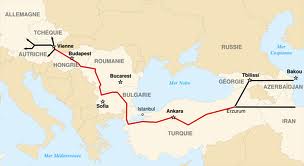
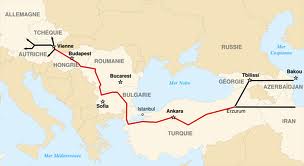
TAP is proposing a route through Albania and Greece into Italy, while the rival Nabucco West project would ship gas along a different path from Turkey's western border into a hub in Austria from whence it could be distributed.

Heavily indebted nation Greece is particularly in need of the kind of investment an energy pipeline would bring and Greek Prime Minister Antonis Samaras attended Wednesday's signing ceremony in Athens.

30 Aralık 2011 Cuma

Turkey Approves Russian Gas Plan


Jacob Gronholt - PEDERSEN       THE WALL STREET JOURNAL


MOSCOW—Russia secured approval from Turkey on Wednesday to build the South Stream gas pipeline across the Black Sea, removing the last major obstacle to proceed with a project that could increase Europe's dependence on Russian natural-gas supplies.
The move heats up the battle between Russia and the European Union over competing pipelines, especially the European Union-backed Nabucco project, and increases pressure on Ukraine to give Moscow control of its pipeline system.
Turkey's approval, given by Energy Minister Taner Tildiz during talks with Russian Prime Minister Vladimir Putin in Moscow on Wednesday, had been a stumbling point for Russia to proceed with the offshore part of the South Stream project.
Russian state gas giant OAO Gazprom ships most of its gas exports to Europe via Ukraine, but supply disruptions in recent years due to pricing disagreements between the two countries have led Russia to seek to bypass Ukraine and promote new pipelines such as South Stream.

1 Aralık 2011 Perşembe

Turkey says will support Azerbaijan gas transit pipeline proposal


Platts

Turkey would support a proposal for a pipeline to carry gas from the second phase of development of Azerbaijan's Shah Deniz gas field to Europe, a spokesman for the energy ministry said Monday.

The proposed pipeline would be in competition with the EU-backed Nabucco pipeline project.

The pipeline proposal was announced Thursday in Istanbul by Rovnag Abdullyev, president of Azeri state oil and gas company Socar, as the Anatolian Transit Gas Pipeline Project. He gave no further details.

The spokesman explained that Turkey and Azerbaijan were working together to develop the proposed pipeline but that no definite decisions had been taken on where the line will start and end or on what the capacity will be.

Broadly it will run from Turkey's eastern border to its western one, and will carry 16 billion cubic meters/year of Shah Deniz gas which Azerbaijan has agreed to export to Turkey and Europe, he said. It could utilize existing sections of Turkey's main east-west transit line in addition to the newly constructed line, he added.

18 Eylül 2011 Pazar

Iraq eyes EU gas exports through Turkey


Kwok W. WAN      Petroleum Economist


LONDON: Iraq wants to export gas found in the blocks on offer in its fourth licensing round
to Europe by pipeline through Turkey and as liquefied natural gas (LNG).


“We are awaiting various development plans for the fields to decide whether we should start work on a gas-export project to the EU through Turkey,” Iraqi deputy oil minister Ahmed al-Shamma told reporters on the sidelines of the Iraq Mining conference on Wednesday. “That’s what we hope to achieve from the fourth round, to discover some good gas reserves to give us assurance for that project.”


Iraq has pre-qualified 46 companies to bid for the 12 blocks, with the deadline for bids in January 2012. The 46 firms include supermajors – BP, Chevron, ExxonMobil, and Shell – national oil companies from China, Malaysia and India, as well as a handful of independents. US independent Hess was excluded because the firm has signed upstream deals with the semi-autonomous Kurdistan Regional Government, which the oil ministry regards as illegal.


12 Ağustos 2011 Cuma

Turkey’s Role in European Energy Security


Dr. Mehmet Efe Biresselioglu*   Natural Gas for Europe      

Ankara’s geography can help boost European energy security

An expert in European geopolitics in the Department of International Relations and the EU at Turkey’s Izmir University of Economics, Dr. Mehmet Efe Biresselioglu contended that there were some basic problems with European energy policy.

“The political reality of the European Union changes when it is faced with energy issues,” he explained. “The EU is divided into two different poles: there are the national decision making centers on one hand, and the EU institutions with powerful transnational political resources on the other. So basically in spite of the liberal inter-governmental setting, and fully integrated political policies, these two different poles mean that the EU is divided over a common energy policy.

“The main obstacle to progress in energy policy is basically the various preferences of the member states, all of which have their different domestic energy resources, different energy requirements and large, state-owned, monopolistic energy industries. All the states have different preferences.”

26 Temmuz 2011 Salı

Azerbaijan looks favorably on Nabucco for diversification


 Abdullah Bozkurt        Today's Zaman

Azerbaijan Minister of Economic Development Shahin Mustafayev has said his country is approaching the European Union-backed Nabucco pipeline project “in a very positive manner.”

Mustafayev, speaking to Today's Zaman in Baku last week, said the Nabucco project, which aims to carry Caspian natural gas supplies to European markets while bypassing the Russian route, is very important in terms of diversification of Azerbaijani energy policies.

“We have to look at the supply side of gas and should enlist more suppliers for Nabucco. The rights of all producers, consumers and transit countries must be protected as well,” he explained.

Nabucco is in competition with two other alternative pipeline projects, namely Interconnector Turkey-Greece-Italy (ITGI) and the Trans Adriatic Pipeline (TAP). All three pipelines will have to pass through Turkey or link to the country's existing network. Following the examination of detailed proposals in October, Azerbaijan is expected to decide which project to prioritize before the end of 2011.

25 Temmuz 2011 Pazartesi

Azerbaijan questions Turkey’s Nabucco moves


İpek Yezdani     Hurriyet Daily News and Economic Review

Azerbaijan has questioned Turkey’s attitude on the Nabucco pipeline project after Baku failed to receive a copy of the signed contract from Ankara, according to a top official from the Caspian nation.

 “Unfortunately nobody sent us the copy of this Project Support Agreement,” Elshad Nasirov, the vice president of the State Oil Company of Azerbaijan, or SOCAR, told the Hürriyet Daily News during a recent interview. “And we will not ask for it, because this will violate the principle of equal treatment for … three projects – Nabucco, the Trans Adriatic Pipeline [TAP] and the Interconnection Turkey-Greece-Italy [ITGI].”
Azerbaijan was the only project partner absent when the legal framework for the Nabucco Pipeline was reportedly signed and finalized on June 8 for the project support agreements, or PSAs, between Nabucco Gas Pipeline International GmbH and the responsible ministries of the five transit countries, Austria, Bulgaria, Hungary, Romania and Turkey.

The signature ceremony was organized just before Turkey’s June 12 general elections in the Central Anatolian province of Kayseri, where Turkish energy minister was running for a seat in Parliament.

22 Haziran 2011 Çarşamba

Nabucco chances grow as Europe’s atomic future dims


Michael KAHN / Sylvia WESTALL

20 Haziran 2011 Pazartesi

A new ‘golden age’ in energy


Gila Benmayor       Hürriyet Daily News and Economic Review

We are entering a phase where interesting developments are being experienced in the world energy market.
Before moving on to the world, first, one piece of news from Turkey.

The Nabucco Natural Gas Pipeline Project, which has not been appearing on the press for a long time, is preparing to come back on the agenda next week on Wednesday with an agreement to be signed in the central Anatolian city of Kayseri.

The fact that European Union Commissioner for Energy Günther Oettinger and Special Envoy of the United States Secretary of State for Eurasian Energy Richard Morningstar will participate at the signing ceremony, which will be held between the energy ministers of those transit countries (Austria, Bulgaria, Romania, Turkey, Hungary) that the natural gas pipeline will pass and Nabucco companies, is a sign of the huge significance Nabucco holds for both Europe and the U.S.

Nabucco’s signing ceremony coincides with the exact period where the world of energy has turned its eyes on natural gas.

9 Nisan 2011 Cumartesi

Turkish-Azeri Gas transit deal may ease caspian supply to Europe


Bloomberg 

Turkey and Azerbaijan will sign a deal for the transit for gas from the Shah Deniz-2 Caspian Sea deposit “shortly,” according to an Azeri official, boosting European plans to diversify supplies away from Russia.
“Everything will be signed very shortly, in several weeks,” Elshad Nassirov, vice president for marketing and investment at the State Oil Co. of Azerbaijan, or Socar, said in an interview in the Azeri capital Baku late Thursday.

All major issues, such as the price and volume of gas to be sold to Turkey from Shah Deniz-2, as well as tariffs for the transportation of fuel through the existing and future pipelines in Turkey have been agreed upon, Nassirov said, without providing details.

The European Union is looking to the Caspian, including Azerbaijan and Turkmenistan, to diversify supply, offset dwindling production and reduce dependence on Russia. Pipeline projects in the bloc’s so-called southern corridor, including OMV-led Nabucco, are seeking supply from Shah Deniz, one of the world’s biggest deposits, as is Russia’s Gazprom.

25 Mart 2011 Cuma

Nabucco Project Adds Options For Gas Producers And Consumers


Vladimir Socor     Eurasia Daily Monitor, Volume: 8, Issue: 56

The Nabucco pipeline consortium is planning an expanded version of this project, within the framework of the EU-backed Southern Gas Corridor to Europe. The added elements include, as distinct possibilities: linking up with Turkmenistan through a trans-Caspian pipeline, to connect with Nabucco via Azerbaijan; inviting Azerbaijan to join the Nabucco consortium; substantially raising the production target for the Shah Deniz field’s Phase Two of development in Azerbaijan; and linking the Nabucco trunkline with the transmission systems of countries in Southeastern and Central Europe, not only along Nabucco’s linear route to Vienna, but also laterally with neighboring countries, thus multiplying the marketing options for Caspian gas in Europe.

Nabucco consortium executives presented some of these planning developments during the annual Turkish Oil & Gas Conference (TUROGE) held on March 17 in Ankara. This process is also ongoing in Baku and, with the European Commission’s assistance, in Ashgabat.

19 Mart 2011 Cumartesi

Nabucco may start gas shipments in 2015


Bloomberg

Nabucco Gas Pipeline International, the planned link to carry natural gas from the Caspian Sea to Europe, may start commercial shipments in late 2015, Managing Director Reinhard Mitschek said on Thursday in Ankara.

The OMV -led project aims to deliver fuel via Turkey, bypassing Russia as part of the so-called Southern Corridor, supported by the U.S. and European Union. Nabucco is vying with projects backed by Norway’s Statoil and Italy’s Edison for gas from the BP-led Shah Deniz venture in Azerbaijan. Russia has also sought to boost purchases of Azeri gas as it competes for European market share.

30 Ocak 2011 Pazar

Azeri leader says feels no Russian pressure over Nabucco


REUTERS


Azerbaijan's leader said on Friday he is under no pressure from Russia to shun the Nabucco gas pipeline, the European Union's attempt to reduce its reliance on Russian supplies.
 
Addressing a panel on European energy security at the World Economic Forum in Davos, President Ilham Aliyev said he was giving equal priority to the Nabucco pipeline -- which pumps Caspian Sea gas to Europe via Georgia and Turkey -- as to other projects involving his Caucasian country's neighbors.

EU diplomats have said Moscow and its gas monopoly Gazprom have spared no effort to try to undermine the Nabucco project, notably by forging ahead with a $25 billion alternative pipeline plan known as South Stream to deliver gas to southern Europe through a pipeline on the Black Sea bed.

Nabucco, which has faced delays over supply talks, aims to transport up to 31 billion cubic meters (bcm) of gas a year from the Caspian region and Middle East to Europe via Turkey and the Balkans.

7 Ocak 2011 Cuma

Barroso to push for Nabucco in Azerbaijan, Turkmenistan


BRUSSELS

European Commission President Jose Manuel Barroso announced Wednesday that he will visit Azerbaijan and Turkmenistan next week to discuss the Nabucco gas pipeline project.

 "I will be traveling next week together with [Energy] Commissioner [Guenther] Oettinger to Azerbaijan and Turkmenistan to push for the Southern Corridor initiative," Russian state news service RIA Novosti quoted Barroso as saying. "Certainly, our goal is to have the clear commitments of those countries regarding the Southern Corridor and including, of course, Nabucco."

Barroso will visit Azerbaijan and Turkmenistan on Jan. 13-15. The Nabucco project hopes to pump gas from the Caspian region to European countries via Azerbaijan, Georgia, Turkey, Bulgaria, Hungary, Romania and Austria while supporters of the project seek to have Azerbaijan and Turkmenistan as major gas suppliers. The project has also sought to secure gas supplies from the Middle East, although tensions in the region continue to overshadow these prospects. So far, no concrete gas supply or purchase commitments have been agreed.

The project is viewed by some as a key element of the Western strategy to reduce Europe's dependence on Russian energy supplies. The project was initially proposed almost 10 years ago but regional politics have since stalled further progress on the project. Investors are expected to make a final decision on the project by the end of 2011.

If built, the $11 billion pipeline project is expected to have an annual capacity of 31 billion cubic meters of gas while a target operational date has been set for 2015. Turkish state-owned crude oil and natural gas company BOTAŞ is one of the major partners of the Nabucco project.