31 Ocak 2011 Pazartesi

For Turkey, Egypt Crisis Holds Risk And Promise


Joe Parkinson        The Wall Street Journal

Turkish officials are watching Egypt's political crisis with a mixture of anxiety and relish, worried that its economy may also be caught up in an investor backlash, but poised for more diplomatic influence as Turkey could become a replacement model for the region's crumbling autocracies.

The anti-regime protests in Tunisia, Egypt and Yemen draw attention to Turkey's success at wedding democratic freedoms with religion. It could emerge as the alternative model for countries that might soon have to choose between a democratic or Islamic administration.

This would deepen Turkey's growing sway in the Middle East. The process began with the election of the Islamist-leaning AK Party, led by Prime Minister Recep Tayyip Erdogan, in 2002, and accelerated as the party won a second election. It is expected to win a third this summer.

Turkey-Australia: More strategy, more depth


Kevin RUDD*      Today's Zaman

That Turkey and Australia are dealing with our strategic challenges in similar ways might be surprising at first glance. However, on closer investigation, it makes sense.
 
We both start from the premise that our national prosperity depends on regional and international stability. Australia and Turkey recognize that safeguarding this stability means building security between states -- developing trust, creating habits of cooperation and encouraging peaceful dispute resolution in our respective regions.

As creative middle powers with global interests, Turkey and Australia both seek a rules based order at both the regional and global levels.

Turkey has transformed its regional and global standing in recent years. Australia’s role has also taken on a new significance as the global centre of geo-strategic and geo-economic gravity shifts to the Asia-Pacific region.

Israel Shaken as Turbulence Rocks an Ally

Ethan BRONNER           The New York Times

The street revolt in Egypt has thrown the Israeli government and military into turmoil, with top officials closeted in round-the-clock strategy sessions aimed at rethinking their most significant regional relationship.

Israel’s military planning relies on peace with Egypt; nearly half the natural gas it uses is imported from Egypt; and the principle of trading conquered land for diplomatic ties began with its 1979 peace treaty with Egypt. Prime Minister Benjamin Netanyahu has met with President Hosni Mubarak of Egypt more than with any other foreign leader, except President Obama. If Mr. Mubarak were driven from power, the effect on Israel could be profound.

“For the United States, Egypt is the keystone of its Middle East policy,” a senior official said. “For Israel, it’s the whole arch.”

Turkey targets 20 nuclear reactors by 2030-official

 REUTERS

Turkey wants to build 20 nuclear reactors by 2030 to produce electricity and reduce its reliance on oil and gas imports, a senior Energy Ministry official said.

Turkey has agreed with Russian nuclear company Rosatom to build its first nuclear power station on the Mediterranean and is in talks with Japan's Toshiba and the Japanese government on building a second plant on the Black Sea.

"We want a minimum 20 reactors in operation by 2030. This may not be our formalised plan, but it is our target," Energy Ministry Undersecretary Metin Kilci told Reuters on Friday.

Turkey has said it wants nuclear to eventually account for most of its power production. Natural gas now fires more than half of Turkish electricity plants.

The government wants to complete talks and prepare an agreement with Toshiba and Japanese officials by the end of March, Kilci said. The Turkish side has yet to decide whether the state will take a stake in the project, he said.

Turkey summons firms to discuss Egypt, Tunisia

REUTERS


Turkey's foreign trade minister has summoned companies that do business with Egypt and Tunisia to discuss measures to limit the impact of political upheaval there, he said on Monday.


Fast-growing Turkey, which has annual trade volume of some $4 billion with the two countries, has set up crisis desks at its Foreign Trade Directorate to deal with the issue, State Minister Zafer Caglayan said in a statement.

Turkey warns EU becoming 'Christian club'

 
AFP


DAVOS, Switzerland — Turkey's deputy prime minister complained on Saturday that the European Union was becoming an inward-looking "Christian club", slamming a lack of progress in his country's bid to join.
Speaking on a panel at the World Economic Forum in Davos that included EU President Herman Van Rompuy, Ali Babacan said: "We always thought the EU is a big peace project... but then the enlargement process literally stalled.

"Open door policy is no longer there," he added.

"And one of the big themes about why Turkey cannot become a member of the European Union is because it is a Christian club. This is in our view very, very dangerous," he said.

Ankara began accession negotiations with the EU in 2005, but the process has stalled amid opposition from some member states, lack of reform in Turkey and a trade row over the divided island of Cyprus.

Syria Strongman: Time for 'Reform'


Jay SOLOMON & Bill SPINDLE   The Wall Street Journal

DAMASCUS—Syrian President Bashar al-Assad, who inherited a regime that has held power for four decades, said he will push for more political reforms in his country, in a sign of how Egypt's violent revolt is forcing leaders across the region to rethink their approaches.

In a rare interview, Mr. Assad told The Wall Street Journal that the protests in Egypt, Tunisia and Yemen are ushering in a "new era" in the Middle East, and that Arab rulers would need to do more to accommodate their people's rising political and economic aspirations.

"If you didn't see the need of reform before what happened in Egypt and Tunisia, it's too late to do any reform," Mr. Assad said in Damascus, as Egyptian protesters swarmed the streets of Cairo pressing for the resignation of longtime President Hosni Mubarak.

The Syrian strongman, who succeeded his father, has always kept a tight leash on his country and tolerated little protest. His regime has also maintained a close partnership with Iran and militant groups such as Hezbollah in Lebanon and Hamas in the Palestinian territories.

Robert Fisk: Egypt: Death throes of a dictatorship


Robert FISK             The Independent 

Our writer joins protesters atop a Cairo tank as the army shows signs of backing the people against Mubarak's regime

The Egyptian tanks, the delirious protesters sitting atop them, the flags, the 40,000 protesters weeping and crying and cheering in Freedom Square and praying around them, the Muslim Brotherhood official sitting amid the tank passengers. Should this be compared to the liberation of Bucharest? Climbing on to an American-made battle tank myself, I could only remember those wonderful films of the liberation of Paris. A few hundred metres away, Hosni Mubarak's black-uniformed security police were still firing at demonstrators near the interior ministry. It was a wild, historical victory celebration, Mubarak's own tanks freeing his capital from his own dictatorship.

In the pantomime world of Mubarak himself – and of Barack Obama and Hillary Clinton in Washington – the man who still claims to be president of Egypt swore in the most preposterous choice of vice-president in an attempt to soften the fury of the protesters – Omar Suleiman, Egypt's chief negotiator with Israel and his senior intelligence officer, a 75-year-old with years of visits to Tel Aviv and Jerusalem and four heart attacks to his credit. How this elderly apparatchik might be expected to deal with the anger and joy of liberation of 80 million Egyptians is beyond imagination. When I told the demonstrators on the tank around me the news of Suleiman's appointment, they burst into laughter. 

Geopolitical Unrest and World Oil Markets


James HAMILTON    Econbrowser

Change is on the way in the Arab world, with Egypt the latest focal point. Here I review recent events and their implications for world oil markets.


I begin with a timeline, if not to connect the dots, at least to collect the dots in a single list. 

Sudan, Jan 9-15: Country holds a referendum whose apparent outcome will be a split of South Sudan into its own a separate country.
Lebanon, Jan 12: Key cabinet ministers resign in protest against impending indictments from a U.N.-backed investigation into the 2005 assassination of former prime minister Rafiq al-Hariri, toppling the governing coalition. U.S. Secretary of State Hillary Clinton offered this assessment:
We view what happened today as a transparent effort by those forces inside Lebanon, as well as interests outside Lebanon, to subvert justice and undermine Lebanon's stability and progress.
Tunisia, Jan 14: President Ben Ali flees the country in response to widespread protests.
Iraq, Jan 17-27: Over 200 people killed in a spate of recent bombings, a sharp and tragic increase from the recent norm.
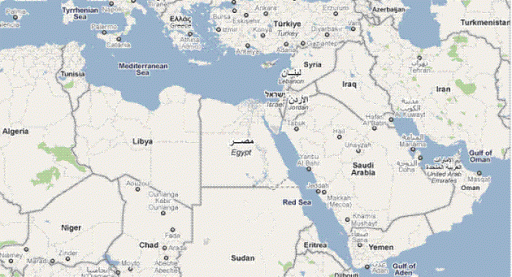
Egypt, Jan 29: Cairo appears to be near anarchy as a result of an uprising against President Mubarak.
Yemen, Jan 29: Demonstrations and rallies have resulted in clashes with police, with unclear implications at this point for the stability of the regime.

An optimist might see the common thread in many of these developments to be the realization across parts of the Arab world of the power of popular will to overthrow dictators, the first step toward democracy and a better life for the people. A pessimist might see in at least some of these situations deliberately orchestrated chaos for purposes of seizing power by a new group of would-be ruthless leaders. A realist might acknowledge the possibility of both factors in play at once, and worry that ideologically motivated uprisings have often turned out to be usurped by groups with their own highly anti-democratic agenda. In the event that some of the transitions of power prove to be more chaotic than peaceful, let me comment on their potential to disrupt world oil markets.

Turkey and EU


Arab News

Why can’t a member of the NATO and OECD be in European Union?

WHATEVER happened to Turkey’s European dream? It’s nearly six years since Ankara began accession negotiations with the EU. Yet the mirage of joining the European club remains just that — a mirage.  No wonder the Turks are getting increasingly frustrated.  Speaking at the World Economic Forum in Davos over the weekend, Deputy Premier Ali Babacan complained that the EU was increasingly becoming an “inward-looking Christian club.”

So what’s hampering Turkey’s EU aspirations? Ankara began its membership negotiations with Brussels in 2005.  And before that the Turks spent years going through numerous stages of reforms and tense transitions to make themselves acceptable and suitable to the privileged club that is the EU.

In its quest for the “holy grail of Europe” Turkey not only had to scrap numerous laws and traditions that Brussels might have frowned upon, it even amended its constitution.  It reached out to all its estranged neighbors and former enemies.  Indeed, the proud Turks who not long ago ruled large parts of the world, including many European lands, were forced to bend over backward to address the demands and concerns of the grouping for that prized ticket to Shangri la.